
The Way We Speak at Home Matters More Than We Think
Sometimes the distance in marriage doesn’t come from big problems—just small shifts in how we speak to each other.

I said something to my wife once that stopped both of us cold.
It wasn’t said in anger. It wasn’t thrown like a weapon or dragged out of some argument that had gone on too long. It just slipped out, quiet and almost tired, the way things do when they’ve been sitting inside you longer than you realized.
“Sometimes I wish you were my friend.”
The room went still after that. Not because it was cruel. But because it was true, and we both knew it, and neither of us quite knew what to do with that.
We Speak Differently to the People We Choose
After that moment, I started noticing something I hadn’t really paid attention to before: the way I spoke to other people.
Friends. Coworkers. The guy at the hardware store I’d never met before and would probably never see again.
With all of them, I was patient. Measured. I thought before I spoke. If a friend misunderstood me, I took the time to explain myself without sighing. If they were having a rough day, I gave them room. If something they said bothered me, I chose my words carefully before I let them out.
But at home? I was quicker. Shorter. More certain that I didn’t need to try as hard.
Not because I didn’t love her. I did. I do. But somewhere along the way, I had started assuming she would understand me without the effort. That she could absorb what everyone else in my life never had to. That love was a kind of shortcut past the work of being kind.
It wasn’t. It isn’t. It never was.
Familiarity Can Make Us Careless
We don’t usually become harsh overnight. It’s not like a switch flips and suddenly we’re someone different. It happens slowly, in the smallest ways, over months and years that blur together.
We stop saying “please.” We stop explaining our tone. We stop softening the edges of what we say before it lands.
Not out of cruelty. Not even out of disrespect, most of the time. It happens out of comfort. And comfort, when we stop paying attention to it, has a quiet way of turning into carelessness.
We start giving the best version of ourselves to the outside world, the patient version, the thoughtful version, the one that pauses before speaking, and then we bring home whatever’s left.
And the person waiting there deserves more than whatever’s left.
The Sentence I Didn’t Expect to Mean So Much
When I said, “Sometimes I wish you were my friend,” here’s what I actually meant, though I couldn’t have put it this clearly in the moment:
I wish I treated you with the same patience I give to people I’m barely even close to. I wish I chose my words with you the way I do with them. I wish I didn’t assume you could carry the weight of my worst moments just because you love me.
I wasn’t asking her to change. I was realizing, slowly and uncomfortably, that I needed to.
What Friendship Still Requires
Friendship has rules we rarely write down, but we follow them anyway, almost instinctively. You don’t assume the worst about someone’s intentions. You don’t speak carelessly and expect them to just absorb it. You don’t unload your frustration without any restraint and call it honesty. You make room for misunderstanding without making it a character indictment.
We honor those rules because somewhere in us we understand that friendship is fragile. That it can be worn down. That it requires a certain kind of care to stay alive.
Here’s the thing: marriage isn’t less fragile. We just act like it is.
A Small Reset That Changed Our Home
We didn’t overhaul everything after that conversation. There was no big reckoning, no dramatic turning point, no list of new rules on the refrigerator. We made one quiet adjustment, almost embarrassingly simple.
Before speaking, especially when something felt tense or frustration was already close to the surface, we started asking ourselves a single question:
Would I say this this way to a friend?
If the answer was no, we paused. Sometimes we reworded it. Sometimes we waited until the temperature had dropped a little. Sometimes we said nothing at all, because we knew that what we had almost said wasn’t ready to be said yet.
It didn’t make us perfect. Nothing does. But it made us more aware, and awareness changes tone. Tone changes conversations. Conversations, over time, change the whole direction of a home. It sounds small because it is small. That’s why it works.
This Isn’t About Being Polished
I want to be clear about something, because I think this can get misread.
This isn’t about being fake. It’s not about tiptoeing around each other or filtering every single thought through some kind of politeness committee before it’s allowed out. Real marriages aren’t like that, and they shouldn’t be.
It’s about remembering that the person you promised your life to is not the place where your respect should go to rest. They’re not the dumping ground for whatever you’ve been holding all day. They are, if anything, the place where that respect should live the strongest, because they’re the one who’s still there every single morning.
If Things Feel Off
If your conversations feel shorter than they used to, if tension rises faster than it should, if the small things keep turning into something heavier than they deserve, it might not be a massive problem. It might not mean something is fundamentally broken.
It might just be tone.
It might just be that slow, almost invisible shift from intention to assumption, where we stop treating our partner like someone we’re choosing and start treating them like someone who’s just… there.
Try This Tonight
Not a long talk. Not a big reset or a serious sit-down conversation. Just this:
Pay attention to how you speak to your spouse for one evening. Not obsessively. Just notice.
And quietly ask yourself, whenever something starts to come out of your mouth: Would I say this this way to a friend?
If the answer is no, adjust. Not dramatically. Just slightly. A little softer. A little more patient. A half-second pause before you respond.
That’s where most real change actually begins. Not in the big gestures. In the small, repeated ones.
One Honest Thought
I don’t wish my wife were my friend anymore.
I’ve learned something I couldn’t quite see before. Friendship is a good standard, but it was never the ceiling. She’s not my friend. She’s more than that. She’s the person I chose, and she keeps choosing me back, and that deserves at least as much care as I’d give a friend, and then some.
That realization didn’t come from a book or a podcast. It came from a quiet, tired sentence that slipped out one evening and landed exactly where it needed to.
If this resonated with you, I write about the quiet patterns that shape a marriage over time, the ones most people don’t notice until a little distance has already crept in. You’re welcome to follow along at The Romantic Husband.
Most marriages don’t need a complete overhaul. They just need a small return to what mattered in the beginning.
If the way we speak to each other shapes a marriage,
then small changes matter.
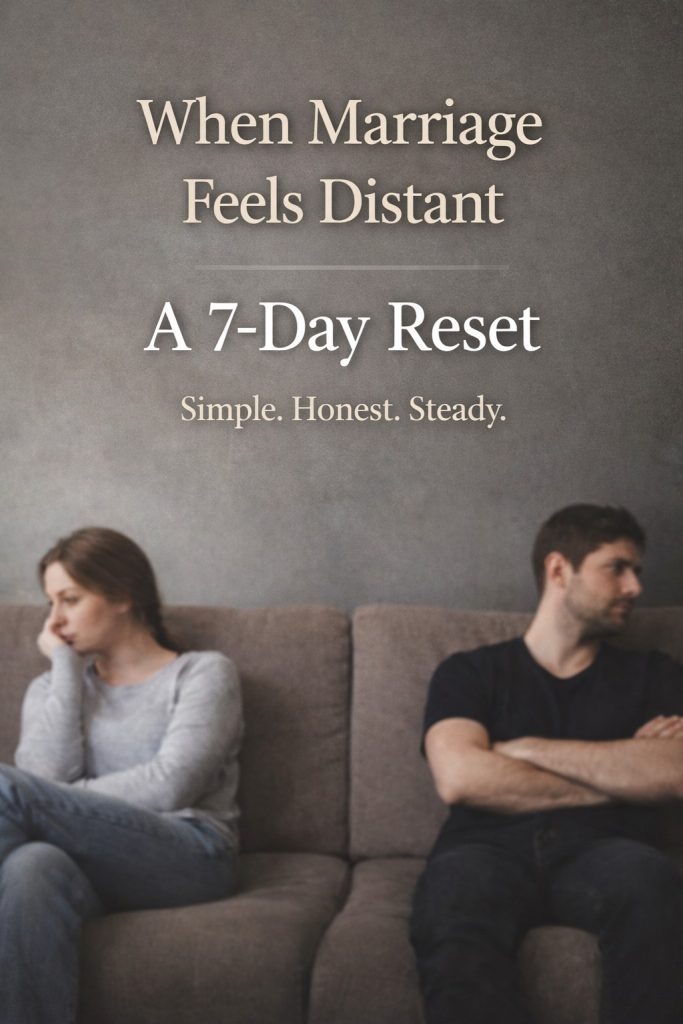
I created a 7-Day Marriage Reset to help you practice those small changes—one day at a time.
Get my free booklet—3 Quiet Signs Your Marriage Is Drifting
👉 https://garywrites.gumroad.com/l/ngxfay
For more articles on marriage and relationships
Follow The Romantic Husband
Continue Reading:
Foundation | Reconnection | Leadership At Home | When Things Are Hard | Reflection