
The Unreturned Mercy
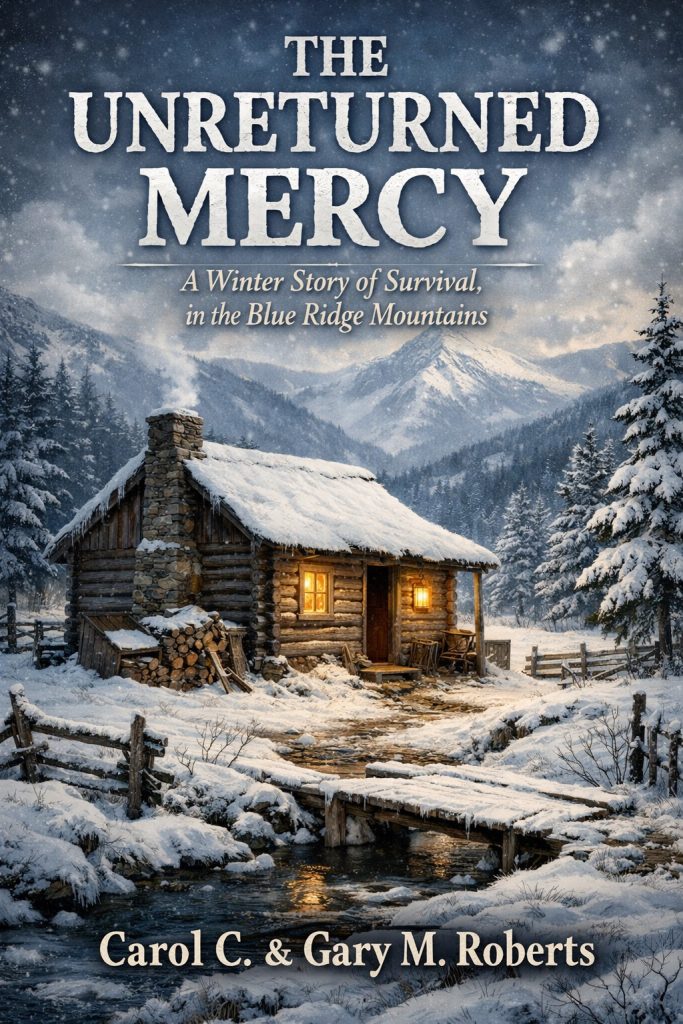
A fifteen-year-old girl fighting to keep her brother alive as winter closes in.
Trapped by a relentless storm in a remote cabin deep within the Blue Ridge Mountains, fifteen-year-old Ruthie Upton faces the unthinkable. Snowed in with her ailing younger brother, Ruthie must fend for them both as hunger gnaws, firewood dwindles, and hope fades. Their father has ventured into the blizzard for help. Their mother is already gone. Every choice becomes a battle for survival—forcing Ruthie to confront hardships she never imagined.
The Unreturned Mercy is a gripping, novella-length historical tale (approximately 17,100 words) of endurance, loss, and the quiet power of grace, set against the stark beauty of the nineteenth-century Blue Ridge Mountains. Written with subtlety and emotional resonance, this story is a haunting meditation on the cost and kindness of mercy—and the ways it forever alters those who give and receive it.
Excerpt From the First Chapter:
Chapter One
Snow fell hard and steady, not drifting but driving—needle-straight, relentless—sealing the mountain shut with its terrible cold hand. It struck the cabin roof with a constant hiss, as if the sky itself were trying to sand the world down to nothing.
Inside, the air was thin and bitter. It smelled of smoke and damp wood and sickness.
Ruthie Upton knelt at the hearth and fed the fire a strip torn from her mother’s dress, testing it the way a person tests the depth of water before stepping in. Her hands shook so badly she had to pinch the cloth between her thumbs to keep it from slipping. Her breath fogged white in front of her face.
The fabric caught quickly.
Silk always did.
It blackened, shrank, and vanished, leaving only a faint, sour smell of burnt cloth and ash—something too fine for a fire, too precious to be fed to it, and yet here it was. Gone in seconds. Like everything else.
Ruthie watched until the last curl of it disappeared, then tore another strip with trembling hands. She laid it on the coals and added kindling on top. The kindling flared and snapped, and she leaned back quickly, more afraid of the flame dying than of it catching her sleeve. She added larger pieces carefully so as not to smother it, arranging them like she’d seen her mother do, long before the coughing started.
Soon a decent fire was going. Not warm—not truly—but alive. She pulled her hands back into her sleeves and held them there, as if she could trap the heat against her skin and keep it from escaping.
She turned toward the mattress on the floor.
The bed was gone. The posts, the slats—burned by her father days before he left.
Ruthie still could not think about that without something tight and bitter rising in her throat. The bed had been the last piece of their old life that had survived the move: the one thing her mother had insisted on bringing, no matter what else they left behind. Now it had become smoke.
Jacob lay on the mattress in short, broken breaths. His face was pale, his lips dry and parted as if he were still calling for someone. His hair stuck to his forehead with sweat, though the cabin was cold enough to freeze a cup of water if it sat too long by the wall.
He had not asked about their father since the snow began to fall in earnest.
Ruthie had told him he would return.
She had said it the way their mother used to say prayers—without hesitation, without promise. She had spoken the words as if speaking them might make them true.
But now she no longer believed them.
It had been three days since her pa left, intent on finding a doctor or anyone at all to help his ailing son.
Three days. In the mountains, in winter, that might as well have been three weeks.
Ruthie could still see him standing at the door, reluctant to leave, yet knowing he had to. His boots were laced tight. His coat hung off him wrong, too big at the shoulders, as if the sickness in the cabin had already started eating him, too. He had a blanket rolled under one arm, a piece of dried venison in his pocket, and his rifle slung over his shoulder. And behind him—nothing but white.
A full week had passed since he buried Ruthie’s mother—his wife—from the same illness that now plagued his son. A week since Ruthie had watched the dirt cover her mother’s face forever. A week since the cabin had gone quiet in a way it had never been before.
Pa left Ruthie with a bundle of firewood, enough for a day and a night. He assured her he would be back by then.
He knew nothing of the storm that would soon assault the land. Or perhaps he knew and simply chose not to say it out loud.
Before leaving, he smiled at Ruthie as if a smile could hold the world together.
“Wind’s pickin’ up,” he said. “Better bundle good for the night. Be spare with the firewood.”
Ruthie nodded and tried to put on a brave face. She had never been left alone at night—not truly. Not without her mother’s soft voice in the dark, not without the steady knowledge that if something went wrong, an adult would wake and handle it.
Now she had a sick brother to care for, and the weight of the whole cabin sat on her shoulders like a stone.
Her pa hesitated at the open door. The cold rushed in around his boots, and the fire in the hearth shivered as if it could feel the mountain watching.
He looked back once more and said, “It’s all goin’ to work out, Ruthie. You’ll see. I’ll be back soon with help.”
Then, as if he needed to hear himself say it, he added, “It’ll get better.”
Ruthie had heard her father say those same words often to her mother.
It’ll get better.
He used to say it the way men say things they want to believe—like hammering a nail into air and hoping it would hold. But it seldom did.
The first year in their new home—this small cabin tucked into the Blue Ridge Mountains of North Carolina—had been nothing but hardship and heartache. Ruthie’s father had come with grand plans: farming, timber, perhaps even livestock. His plans were always grand. They were the kind of plans that sounded fine when spoken aloud, especially in front of neighbors, especially when he was still full of hope.
Then reality set in. The soil was thin and stubborn. Their meager crop failed miserably, costing almost all their seed. The corn came up sickly and yellow. The beans barely climbed. Even the pumpkins rotted before they ripened, as if the earth refused to feed them.
Ruthie’s pa—a man with few skills and fewer instincts—found hunting game difficult and unpleasant. He would come home angry, empty-handed, blaming the woods for being too quiet, blaming the weather for being too harsh, blaming anything but himself.
Within a few months they were forced to butcher the hogs that were meant to be the start of their farm, along with most of their chickens for meat. Ruthie remembered the sound of the axe, the hot metallic smell of blood in the yard, and the way her mother had turned her face away but still whispered thanks under her breath, as if gratitude might keep them from turning into animals.
Cold weather and scarce food took their toll quickly. Ruthie’s mother got sick even before the little cabin was finished.
Her mother spent her days trying to help as much as she could, stirring thin soup, mending clothes, cutting wood with hands that shook—until her cough got so bad she found it hard to breathe.
At first, Ruthie thought it was only a cold, just a passing illness. Then she began waking at night to the sound of her mother coughing in the dark, deep and wet, like something was tearing loose inside her chest. Ruthie would lie very still, listening, her heart beating fast, and she would pretend she did not hear the fear in her father’s breathing when he woke too.
Finally, her mother’s body simply gave out.
Even the cold ground seemed to refuse them. It took well into the night for Ruthie’s pa to dig her final resting place, the shovel striking rock again and again, each sound sharp as gunfire in the quiet.
When it was finished, there were no words said.
No prayer. No hymn.
Just dirt shoveled, the hole filled, and the world left exactly as it was—only emptier.
Afterward, Ruthie stood in the dark with her hands buried in her sleeves, watching her father stare at the mound as if waiting for it to move.
All that was left was emptiness that could not be filled.
And now the sickness had taken Jacob too, as if it had simply moved through the cabin like a spirit looking for the next warm body.
Ruthie looked at her brother and then at the fire. The fire would not last long. Nothing in that cabin lasted long.
She stood and brushed the ash from her skirt with slow, deliberate strokes, as if tidying could keep panic from getting in. Her knees ached from the cold floor. The boards were rough beneath her, and the draft that slipped through the cracks carried the mountain’s breath straight into her bones.
Her brother was but five; she was fifteen and the woman of the house now, and he was hers to care for. It was a task that was unbearable for one even twice her age.
Get your copy today to finish reading…
Available in Kindle, Audio, and Paperback
If you enjoy stories like this, join my reader list and receive a free book.
From the author of:
When Marriage Feels Distant
A 7-Day Reset